Author: RampHead (Page 13 of 15)

Ramp Bulbs Update – Last Week To Order

By now I hope several of you that have bought bulbs have had time to get them in the ground. The second round of orders should be arriving to everyone tomorrow or Wednesday. (Make sure you water them heavily after planting!)

The next orders of ramp bulbs will be shipping out on Monday 3-23-2015 and Tuesday 3-24-2015. If you want to plant some bulbs, please get your orders in before then. Some of the bulbs have started poking their heads above the ground, so I expect that in two weeks you will be ordering what you have been waiting on for so long….

This is an older picture, but we will be there in a couple of weeks. I know I can’t wait to get some of these in my belly along with some fried potatoes and bacon. Delicious!

Soon….very soon!

For now though, they’re still just bulbs. If you are interested in the bulbs, the order page with qty and pricing information is located here:  Ramp Bulbs for sale.

Who Wants Ramp Bulbs?

Greetings and Happy New Year once again to all of my fellow ramps connoisseurs.

I hope that the past year was good to you and I hope that 2015 is an even better year for you.

I have a question I would like to ask you today.

(PSSST… We’ve got a facebook page now. Give us a like. See it over there on the right? ———>)

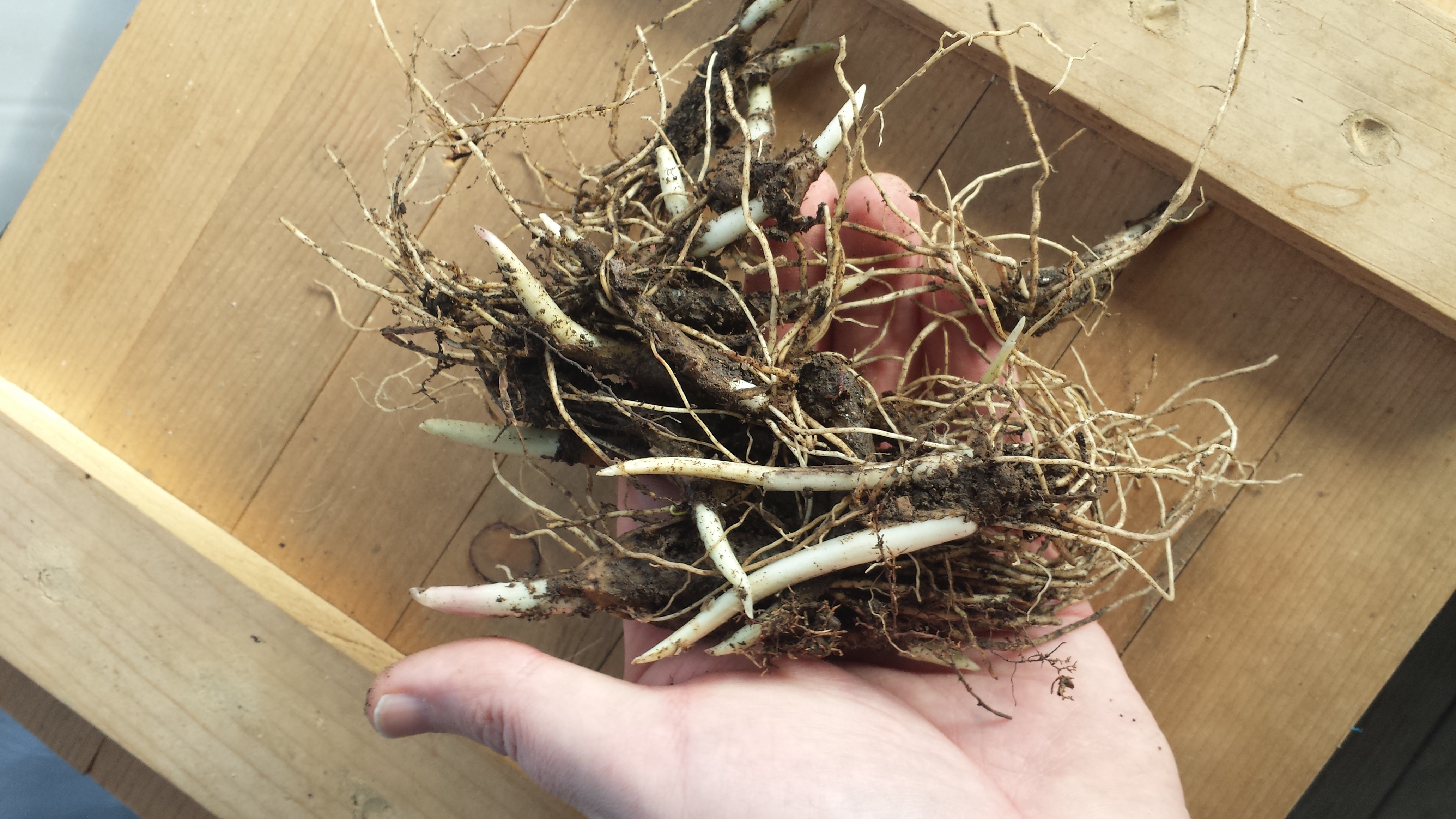
Would you be interested in purchasing ramp bulbs before the official ramp season is underway? Ramp bulbs are easy to plant and a great way to get a head start on growing your own bumper crop, or just growing some so you will be able to pluck them fresh out of the ground, flower pot, or unique raised bed ramp garden that you create. (I’ve seen some really nice raised bed gardens that are just begging to have a few dozen ramps planted in them.)

Of course the ramp bulbs would be shipped complete with roots for transplanting, and would look very similar to this:

west virginia ramp bulbs

The bulbs are small because they shrink during the winter months, but quickly swell again as the sunlight warms the ground and the green leaves make their way to the sky.

So before I go out into the cold and begin harvesting bulbs, I would like to know if there is any interest in them. If you think you would like some, please leave me a comment in the space provided below. This in no way commits you to buying them if I sell them, but it gives me an idea as to whether or not it would be a worthwhile endeavor on my part.

How should I plant and grow these ramp bulbs?

For best growing results mimic how and where the ramps grow in the wild. In the wild Ramps grow in shaded areas (usually under trees) with an abundance of moisture and soil rich in organic matter. Look carefully around your gardening area for a tree that will provide a moist soil with lots of shade. Organic matter such as leaves should be abundantly added. Ramps grow naturally under a forest canopy of beech, birch, sugar maple, and/or poplar. Other forest trees under which ramps will grow include buckeye, linden (basswood), hickory, and oak. A forested area with any of these trees present provides an ideal location for planting a ramp crop. Areas that host trillium, tooth wort, nettle, black cohos, ginseng, bloodroot, trout lily, bell wort, and may apple should be suitable for growing ramps. If there is not a wooded area available to grow ramps, a shade structure can be erected over the planting site.

Hardwood leaves provide the best mulch for ramps. Poor results have been obtained with pine bark and commercial mulches and they should be avoided. The effects of mulching are numerous: decaying organic matter provides essential elements like nitrogen, much needed moisture is retained within the mulched area, and the mulch acts as an insulator to protect the plants in sub-zero temperatures. In addition, mulching helps to suppress weeds as well as protect newly sown seeds, seedlings, and ramp bulbs from wildlife.

I would rather plant my ramp bulbs in the woods.

That’s a great idea also! To plant under a forested canopy, rake back the leaves on the forest floor, removing any unwanted weeds, tree sprouts, or roots. If the soil is not naturally high in organic matter, incorporate organic materials such as composted leaves and other decaying plant material from the forest. Loosen the soil and rake to prepare a fine bed. Sow bulbs about 1/2 to 1 inch a part pressing them gently into the soil. Cover bulbs with several inches of leaves to retain moisture in the soil and to protect the bulbs from the wildlife. When using artificial shade, ensure that you till plenty of organic matter into the soil prior to sowing your bulbs.

We Only Have A Few Bottles Of Ramp Seasoning Left

This has been a wonderful new product for us and we are nearly out. We only have a few bottles of ramp seasoning left, so if you want some you had better act fast. A super huge thank you to all that have ordered the ramp seasoning. I do have one favor to ask of you…if you bought some and you like it, please facebook it or twitter it for me? I would love to be able to clear out the rest of my inventory for fall.

Thank you guys so much.

UPDATE: SOLD OUT!!

ramp seasoning

A little goes a long way!

Poke Salad, Poke Greens, Poke Salat, Poke Weed

Poke Salad, Poke Greens, Poke Salat, Poke Weed

Poke Salad, Poke Greens, Poke Salat, Poke Weed

Since there is not much going on around here while wild ramps are out of season (seeds should be available soon!), so I thought I would make a quick post about another favorite food of us mountain folk.

Pokeweeds, also known as poke, pokebush, pokeberry, pokeroot, polk salad, polk salat, and inkberry is another spring tradition around these parts.

As this plant can be toxic if not prepared correctly, precautions must be taken to ensure it is fit for consumption.

Young pokeweed leaves can be boiled three times to reduce the toxin, discarding the water after each boiling. The result is known as poke salit, or Poke salad, and is occasionally available commercially.

Many authorities advise against eating pokeweed even after thrice boiling, as traces of the toxin may still remain.

For many decades, Poke salad has been a spring favorite West Virginia cuisine, despite campaigns by doctors who believed pokeweed remained toxic even after being boiled.

My Granny and I have been eating this stuff for years, and I bet her Granny used to eat it also. It tastes a lot like spinach. I like taking a heaping spoonful, putting it in a bowl, giving it a good dose of salt and pepper, and then smothering it with vinegar. Tasty!

Here is a snippet of an article I found online with some useful information:

Pokeweed is a perennial herb that is native to North America, South America, East Asia, and New Zealand. It was introduced to European settlers by Native American Indians. Now you can find pokeweed cultivated in Europe and throughout the world.

This plant grows from 1 ft.-10 ft. tall. All parts of the plant are poisonous to cattle, horses, swine, and humans if eaten raw; the roots being the most poisonous. Swine are able to pull up the roots (even though they grow deep) and eat that part of the plant but it usually kills them. The pokeweed plant contains several toxins as well as histamines.

Birds eat the berries and because the berries are swallowed whole the birds aren’t harmed. Then when the birds do what comes naturally to them, new plants will spring up in the meadows and fields.

There are many uses for the pokeweed plant such as the juice from the berries are used in crimson dyes and in the earlier days of America, ink was made from the berry juice. People who work with natural fibers now will use pokeweed berry juice to dye the fabrics they create. The food industry still uses the pokeweed berries to make red food coloring.

The berries and dried roots are used in herbal remedies even today. Research shows that pokeweed contains compounds that seem to enhance the immune system. Young pokeweed shoots contain low levels of toxins and were used by Native Americans and European settlers as food.

Research has shown that the pokeweed has anti-cancer properties in animal studies. More research needs to done on humans to see if the same results will prove to be a positive step in cancer treatment. Pokeweed has an antiviral protein (PAP) that is believed when used in certain formulas may be useful against cancer cells that depend upon hormones for their growth; such as the cells from breast, ovarian, and prostate cancer.

There are many claims that supplements made from the pokeweed and taken internally will help treat rheumatoid arthritis, joint inflammation, breast abscesses, and a host of other conditions.

If you have never picked poke salad, take someone who is familiar with the plant. They will also tell you how to pick and prepare it.

Most people will wash the leaves, put in boiling water for 5 min., then pour off the water, and repeat this 2 or 3 times. After the last boiling they will squeeze excess water from the leaves. Pour a little oil in the  skillet, put the poke salad in the hot oil, then add eggs as many as you like, salt, and pepper to taste.

If you’ve never eaten poke salad, always taste cautiously to make sure there is no allergy. Probably less than 1% of the world would be allergic to pokeweed and it would only be important if you were in that group.

Baby Pheasants While Ramp Digging

Today was the last day of the year we went out digging for fresh ramps. The last orders with ship on 5/5. We have enough to fill all of last weeks orders and we dug even more in order to make several more batches of Ramp Seasoning. If you missed out on fresh ramps this year, do try the seasoning. It’s tastes great and can be used in a variety of dishes.

I have a bit of a story to tell you about todays adventure. My wife and I were walking up a small embankment when a Pheasant or Ruffed Grouse flew right up in front of us. It went about 20 feet, hit the ground and started flopping around like it was wounded. I knew from experience that a mother with small young would do this to lure a predator away from her young if she felt they were threatened. I looked down at my feet and there were three teeny tiny itty bitty chicks laying motionless. One was literally at the tip of my shoe. I had nearly stepped on it. Its hatch mates were only a few inches away from it. I pointed them out to the wife and we ooohed and ahhhed over them for a few minutes. The mother was still flapping in the leaves trying to divert our attention.

I snapped a picture of them before we continued on our way. When we got up a little higher, we watched momma come back, rustle up her young’uns, and quickly lead them in another direction. I hope we didn’t disturb the momma or the baby pheasants too much. Spring is such a wonderful time of the year to be out and about in the woods.

Baby Pheasants

One Baby Pheasant

Baby Pheasants 2

Another Baby Pheasant

You can click on the images to make them larger. Cute little guys, aren’t they?

The Appalachian Delicacy

This is the last week to buy ramps from me. The last shipment of fresh ramps for the year will be going out on 5/5.  We are lucky we got as many weeks in as we did this year. It turned out to be the longest season we’ve had in a couple of years. So, if you want more ramps, order them now.  Also, the ramp seasoning was a hit. I knew that our supply would sell out, but I didn’t realize it would sell out in less than 12 hours. We are currently in the process of making more, and I hope to have it ready by this weekend. Keep checking the ramp seasoning page for an update of when it is back in stock. Or, sign up for the mailing list over on the right and I will send everyone an email when it is ready.

One more thing. A young lady asked me if she could write a few words about her and her friends ramp digging, and put it here. I have no problem with that and I didn’t figure you guys would either. Enjoy her story!

Everybody talks about the pungent odor of ramps, but digging the Appalachian delicacy produces a different set of concerns: My legs are tired. My back is hurting. I am hungry. My nose is running. And my burlap bag is filling very, very slowly. I have come to this hillside with a group of friends who had eaten ramps at a neighbor’s house and wanted to try to dig them up and make them themselves.

I had gone before and wanted to help them out. I led them across a rocky slope and into the fog where the hillside is covered by long, green leaves. Those are the ramps. They almost look like thick hair there are so many. The hillside is steep and chilly and damp. It is a hike to get up to where the ramps actually are and we are all slightly winded by the time we make it up to our spot.

Some people think it’s easy to dig up a wild ramp but it is not! You are bent over and crouched, whacking away at them. My friends have never done this before and didn’t quite know what to expect. Luckily I thought to remind them to dress warmly and wear sturdy shoes. My friend Marie is winded before we are even halfway up the slope.

When we finally get to where the most ramps are, they are all amazed by how many there are. I let them start digging and go around and give them tips to make it easier on them. Our goal is to fill one sack each because if we trudged all the way up here then we wanted to make sure it was worth it. At the beginning we were joking and laughing about the task in front of us but now that the work is under way we’ve gotten a little quieter. Oh of course we still laugh when Laurel falls on her butt in the mud with a ramp in her hand. She laughs with us and I realize that doing this with friends makes it way more fun!

As we each fill our own sack we help each other with the rest of them, trying to spread out the work. By the time they’re all filled we have all fallen in the mud at least once (or 4 times in Kari’s case!), we’re soaked through our clothes and really, really hungry. And we still had to get these bags back down the hill! Marie tried rolling hers. I just sat back and let her try even though I knew that didn’t work. After her ramps started to fall out she caught the bag and looked at me for directions. I slung the bag over my shoulder and started walking down the hill.

The girls all followed me, one even started whistling “Hi ho hi ho” from Snow White. By the time we got to the bottom we were muddier still! We washed off our hands in the creek and piled the bags (and ourselves) into our cars. We definitely deserved a nice hot lunch at the local diner after this trip!

Appalachian Delicacy

« Older posts Newer posts »
Wild West Virginia Ramps